Automating routine work. Everywhere.
7th Unit builds general-purpose humanoid robots that automate entire shifts of work.
Get in touch →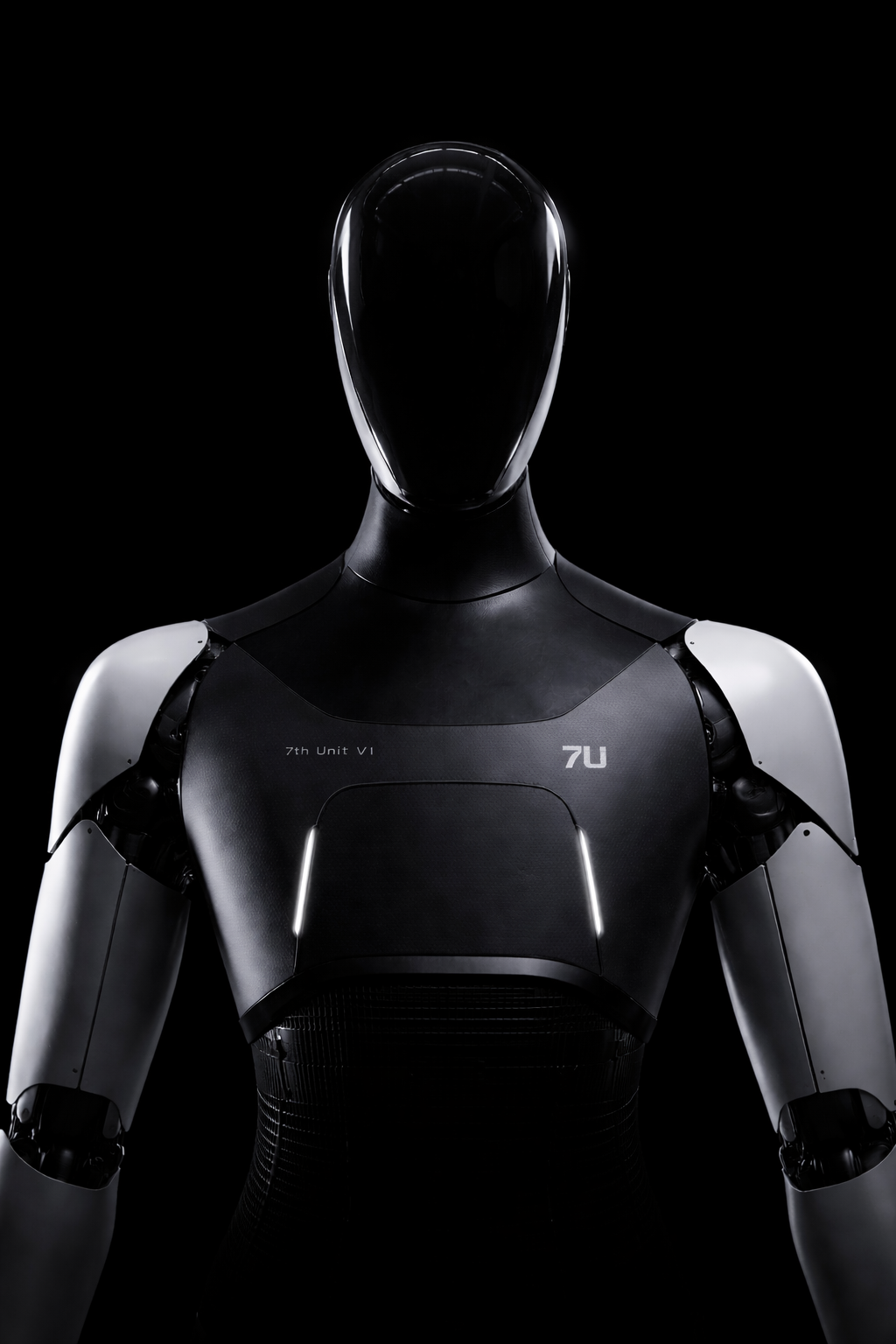
7th Unit builds general-purpose humanoid robots that automate entire shifts of work.
Get in touch →
The Challenge
The global workforce is decreasing, ageing and moving away from undesirable, unsafe, and repetitive tasks
The working-age population is shrinking across every major economy. Workers are leaving physically demanding, repetitive roles and not coming back. By 2030, 85 million jobs will go unfilled globally — representing $8.5 trillion in unrealized economic output every year. Only 20% of the physical work performed across the $90 trillion global industrial sector is automated today. The remaining 80% — every task that requires a human body, a pair of hands, and the ability to move through a real environment — has no viable solution. That is what 7th Unit is building for.
The Opportunity
According to Goldman Sachs, the total addressable market for humanoid robots is projected to reach $38 billion globally by 2035 and $1T by 2050, driven by acute labor shortages and demographic pressures across developed economies.
The potential of humanoid robots is enormous, and we identify three significant business opportunities in the long run.
2027
Robots will transform manual work in manufacturing, warehousing, logistics, and retail, tackling repetitive, dangerous, and tedious tasks.
2029
Services will comprise 70–80% of the global economy, with 1.4B people over the age of 60. Humanoid robots will play a critical role in the service sector workforce.
2031
From 2031 onwards, robots will revolutionize everyday life across 3.5 billion households, efficiently managing routine chores as assistants and providing comprehensive home care as companions.
Humanoid robots have long been a dream, limited by cost and technical hurdles. Today, a perfect storm of robotics and AI advancements is making them real. Faster hardware, smarter AI, and new learning methods allow machines to think, move, and act with human-like precision.
Generative AI and multi-modal models are teaching robots to learn by observing and imitating — in the real world and through data-driven simulations. Robots are beginning to share knowledge through cloud networks, accelerating collective intelligence at an unprecedented pace.
At the same time, labor shortages and demographic shifts are creating urgent demand. Across factories, warehouses, and care facilities, humanoid robots can now take on dangerous, repetitive, or complex tasks — freeing humans for more meaningful work and delivering measurable economic impact.
→ Learn more about our approachSolution
Traditional automation replaces a single task. A conveyor moves one thing. A robotic arm performs one operation. 7th Unit replaces a worker — and a worker does many things across a shift. Our full humanoid platform combines navigation, manipulation, and contextual awareness in a single deployable unit, executing multi-step workflows across an entire working day. From moving inventory across a warehouse to handling multi-step back-of-house operations. The human form is not an aesthetic choice — the world is already built for humans, and our robot inherits that infrastructure on day one with no facility redesign required.
We build the hardware and own the intelligence layer — the skill library and fleet learning system that makes the robot more valuable with every deployment.
Advantage
We build the hardware and the brain. Our robots learn directly from real workflows in real customer environments — not controlled lab datasets. Every deployment generates proprietary skill data that feeds back into the platform, making every subsequent deployment faster and more capable.
Roadmap
Months 1–3
Finalize technical architecture. Assemble founding engineering team. Source components. Begin hardware build.
Months 4–7
Build and test the alpha platform. Complete task-specific training for the pilot customer environment. Validate performance against conditions in signed agreements.
Months 8–10
Deploy the alpha unit inside a paying customer facility. Generate real operational data — hours logged, tasks completed, error rates, documented cost savings.
Months 11–12
Compile deployment data. Refine hardware and software based on real-world feedback. Series A round with a deployed robot and real operational data in hand.
Founder

Alex Mokrov
Founder & CEO
From a young age Alex observed the workers at a close family friend's construction company — exhausted men doing backbreaking physical work day after day, weekends included, for wages that barely covered bread. Traveling the world across Asia, Africa, and Europe, he kept encountering the same picture: people performing physically brutal, repetitive work in conditions no person should endure. Millions of people still live and work this way today. Alex believes that humanoid robots can free people from the most degrading and repetitive physical labor, allowing them to live and work with greater dignity. This belief is what drives him to build 7th Unit — and the technology to finally make it real has arrived.